
Answer First: The best AI CRM software in 2026 depends on your sales model. HubSpot is our best overall pick for growing teams, Salesforce is strongest for complex enterprise CRM and AI agents, Zoho CRM offers the best value, Pipedrive is best for simple pipeline management, monday CRM stands out for flexible AI-agent workflows, and Close is the strongest choice for outbound sales teams that rely on calling, email, SMS, and automated follow-up.
AI CRM software has moved beyond email-writing assistants.
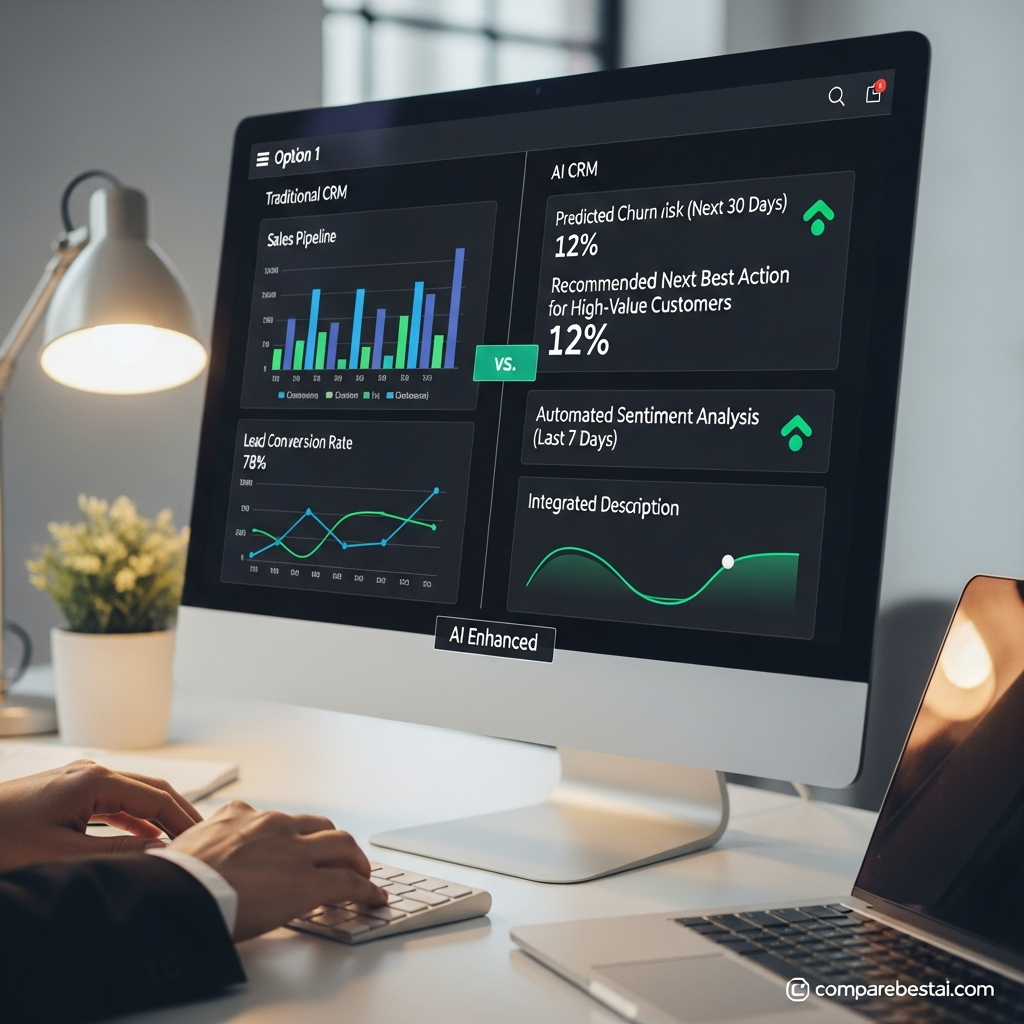
The strongest platforms now use AI to enrich CRM records, summarize conversations, identify risky deals, recommend next actions, score leads, forecast pipeline performance, automate follow-up, and—in some cases—deploy agents that can execute tasks themselves.
The right choice depends less on which CRM has the most AI features and more on which AI features actually match your sales process.
You can browse more Sales & CRM tools on CompareBestAI.
Best AI CRM Tools: Quick Comparison
| CRM | Best for | Starting price* | AI strength |
|---|---|---|---|
| HubSpot | Best overall for SMB and mid-market | Free | Unified CRM, Breeze, enrichment, agents |
| Salesforce | Enterprise CRM and agentic AI | $25/user/mo | Agentforce, predictive AI, complex automation |
| Zoho CRM | Best value | Free; paid from $14/user/mo | Zia scoring, predictions, recommendations, agents |
| Pipedrive | Simple sales pipelines | $14/user/mo | AI Sales Assistant, reports, summaries, scoring |
| monday CRM | Flexible AI workflows | $12/seat/mo | AI agents, meeting prep, lead sourcing, workflows |
| Close | Outbound sales teams | $9/user/mo annually | Chloe AI voice agent, summaries, CRM actions |
*Published vendor prices vary by billing cycle, edition, region, seat count, promotional offers, and AI usage.
What Is an AI CRM?
An AI CRM is customer relationship management software that uses artificial intelligence to help teams manage, interpret, and act on customer and sales data.
A useful AI CRM should do more than generate an email.
Look for capabilities such as:
- automatic data enrichment;
- predictive lead or deal scoring;
- conversation summaries;
- next-best-action recommendations;
- forecast insights;
- anomaly or risk detection;
- natural-language reporting;
- automated follow-up;
- intelligent workflow automation;
- autonomous sales or service agents.
The question is therefore not simply:
“Does this CRM have AI?”
It is:
“Where does the AI sit inside my actual sales workflow?”
1. HubSpot — Best AI CRM Overall for Growing Teams
HubSpot is our best overall recommendation for most small-to-mid-sized organizations because its CRM combines customer data, sales workflows, marketing, service, reporting, automation, and AI in one ecosystem.
HubSpot's free CRM currently includes contact management, deal pipelines, CRM import, dashboards, and Breeze Assistant. Paid CRM tiers add deeper automation, scoring, reporting, permissions, AI agents, and customer-data functionality.
HubSpot AI features
HubSpot's Smart CRM uses AI for functions including:
- Breeze Assistant;
- automatic customer-data enrichment;
- intelligent recommendations;
- duplicate and data-quality management;
- prospecting agents;
- customer agents;
- AI CRM insights;
- workflow automation.
HubSpot says some AI features are included with subscriptions while certain agent workloads consume HubSpot Credits.
HubSpot pricing
HubSpot currently offers a free CRM.
Its mainstream CRM page lists:
Free: $0
Starter: from $15/seat/month
Professional: from $50/seat/month
Enterprise: from $75/seat/month.
Standalone Smart CRM pricing differs slightly based on commitment and packaging, so buyers should verify the current checkout page.
Best for
HubSpot is particularly well suited to:
- startups;
- SMBs;
- marketing-led sales teams;
- growing B2B companies;
- teams wanting one CRM across marketing, sales, and service.
Main limitation
HubSpot becomes significantly more expensive as companies move into advanced automation, AI, reporting, and larger teams.
If you only need a sales pipeline, Pipedrive or Close can be simpler.
Read CompareBestAI's HubSpot AI profile.
Best overall: HubSpot.
2. Salesforce — Best AI CRM for Enterprise Teams
Salesforce remains the strongest choice when CRM complexity, customization, enterprise governance, large datasets, and agentic workflows matter more than simplicity.
Salesforce's current sales platform combines traditional CRM functionality with predictive AI, conversational intelligence, automation, Data Cloud, and Agentforce.
What is Agentforce?
Agentforce is Salesforce's AI-agent platform.
Salesforce describes Agentforce as capable of retrieving business knowledge, reasoning through requests, and taking actions on behalf of users.
Agentforce can be used for customer-facing and employee-facing workflows rather than merely generating text suggestions.
Salesforce pricing
Salesforce pricing is more complex than the other CRMs in this list.
Current sales pages include editions such as:
Starter Suite: $25/user/month
Pro Suite: $100/user/month
Enterprise: $175/user/month
Unlimited: $350/user/month
Agentforce 1 Sales: $550/user/month.
Salesforce also offers separate Agentforce consumption models, including Flex Credits and per-conversation pricing.
Best for
Salesforce is strongest for:
- large enterprises;
- complex B2B sales processes;
- multinational organizations;
- companies requiring extensive customization;
- organizations building autonomous CRM agents;
- teams with dedicated RevOps or Salesforce administrators.
Main limitation
Salesforce can require substantially more implementation, administration, configuration, and budget than lighter CRM platforms.
A 10-person sales team that only needs pipeline management may be paying for infrastructure it never uses.
Compare the dedicated Salesforce Agentforce profile.
Best enterprise AI CRM: Salesforce.
3. Zoho CRM — Best AI CRM for Value
Zoho CRM offers one of the strongest price-to-feature ratios in the CRM market.
Its AI assistant, Zia, covers predictive sales intelligence, recommendations, data management, customer insights, automation, generative AI, and increasingly agentic workflows.
What can Zia do?
Current Zia functionality spans areas such as:
- prediction;
- recommendations;
- sales insights;
- anomaly detection;
- customer engagement;
- data enrichment;
- communication assistance;
- record summaries;
- workflow intelligence;
- conversational Ask Zia;
- Zia Agents.
Zoho's latest documentation also supports generative AI models inside CRM and agentic workflows.
Zoho CRM pricing
Current annual pricing includes approximately:
Free: $0 for up to three users
Standard: $14/user/month
Professional: $23/user/month
Enterprise: $40/user/month
Ultimate: $52/user/month.
Zoho's official 2026 edition guide says Zia predictions, scoring, and recommendation capabilities are partial in Professional and broader in Enterprise and Ultimate.
Best for
Zoho is particularly good for:
- budget-conscious SMBs;
- companies already using Zoho;
- international teams;
- businesses needing advanced CRM at a lower per-user cost;
- teams willing to accept a steeper learning curve.
Main limitation
The interface and configuration model can feel more complex than HubSpot or Pipedrive.
Zoho also has enough features that setup can become overwhelming if your CRM needs are basic.
Explore Zoho CRM with Zia.
Best value: Zoho CRM.
4. Pipedrive — Best AI CRM for Simple Pipeline Management
Pipedrive is built around one core concept:
help sales teams move deals through a pipeline.
That focus makes it easier to adopt than broader platforms built to manage marketing, service, operations, commerce, and sales simultaneously.
Pipedrive's current AI Sales Assistant can analyze CRM data, summarize deals, identify patterns, surface performance trends, highlight opportunities, and answer natural-language questions about the pipeline.
Current Pipedrive AI features
Current AI functions include:
- AI-assisted report creation;
- AI import assistance;
- AI marketplace recommendations;
- Sales Assistant;
- smart sales notifications;
- deal summaries;
- performance analysis;
- win-probability insights;
- AI email features on higher tiers.
Pipedrive's September 2026 documentation shows several core AI features available across all four plans.
Pipedrive pricing
Current annual pricing is:
Lite: $14/user/month
Growth: $39/user/month
Premium: $59/user/month
Ultimate: $79/user/month.
All currently include a 14-day free trial.
Best for
Pipedrive is ideal for:
- small and medium sales teams;
- pipeline-driven businesses;
- companies migrating from spreadsheets;
- managers who want visual sales reporting;
- teams that do not need a full marketing platform.
Main limitation
Pipedrive is less comprehensive than HubSpot or Salesforce for companies that want CRM, marketing, service, customer support, and sophisticated enterprise data infrastructure under one vendor.
See Pipedrive AI.
Best for pipeline simplicity: Pipedrive.
5. monday CRM — Best for Flexible AI-Agent Workflows
monday CRM has changed significantly in 2026.
It is no longer just a colorful board system with a few AI writing features.
The current CRM pricing page explicitly promotes AI agents that can source leads, call and qualify prospects, prepare sales reps for meetings, take meeting notes, populate intelligent fields, and execute workflows.
monday CRM AI features
Standard and higher plans currently advertise capabilities such as:
- Outreach Caller Agent;
- Lead Sourcer Agent;
- custom AI agents;
- Meeting Prep Agent;
- AI meeting notetaker;
- Sidekick AI assistant;
- AI-powered data fields;
- workflow automation.
Pro also adds an AI workflow builder.
monday CRM pricing
With annual billing, current pricing begins at approximately:
Basic: $12/seat/month
Standard: $17/seat/month
Pro: $28/seat/month
Ultimate: custom.
Paid plans begin at a minimum team size, and monday offers a 14-day trial rather than a permanent free CRM edition.
Best for
monday CRM is a strong fit for:
- flexible sales operations;
- cross-functional teams;
- organizations connecting sales to delivery/projects;
- teams wanting customizable no-code workflows;
- companies interested in practical AI agents without moving to Salesforce.
Main limitation
The flexibility can become a disadvantage.
A heavily customized monday implementation may require more design and governance than a purpose-built pipeline CRM such as Pipedrive.
Read the monday Sales CRM AI profile.
Best for flexible AI workflows: monday CRM.
6. Close — Best AI CRM for Outbound Sales
Close is built specifically for teams that sell through calls, email, SMS, and high-volume follow-up.
Instead of requiring separate dialer, sequencing, messaging, and CRM tools, Close combines these functions inside one sales platform.
Its biggest 2026 AI development is Chloe, Close's native AI sales teammate.
What does Chloe do?
Close says Chloe can:
- call leads;
- qualify prospects;
- conduct voice conversations;
- answer questions about CRM data;
- summarize pipelines;
- create tasks;
- update records;
- log outcomes and transcripts.
Chloe is integrated into Close rather than operating as an external plug-in.
Close pricing
With annual billing, current pricing is:
Solo: $9/user/month
Essentials: $35/user/month
Growth: $99/user/month
Scale: $139/user/month.
AI credit allowances rise with each tier.
Close also sells Call Assistant separately for $50/month per organization plus usage fees for call transcription and summarization.
Best for
Close is particularly strong for:
- SDR teams;
- outbound sales teams;
- phone-heavy sales operations;
- startups doing high-volume prospecting;
- organizations replacing separate CRM + dialer + SMS tools.
Main limitation
Close is sales-centric.
Businesses wanting extensive inbound marketing, customer service, commerce, CMS, or enterprise data infrastructure should look at HubSpot or Salesforce.
See the Close AI CRM profile.
Best for outbound: Close.

Best AI CRM by Use Case
| Use case | Best choice |
|---|---|
| Best overall | HubSpot |
| Small business | HubSpot / Zoho |
| Best value | Zoho CRM |
| Enterprise | Salesforce |
| Agentic AI | Salesforce / monday CRM |
| Simple sales pipeline | Pipedrive |
| Outbound calling | Close |
| Marketing + CRM | HubSpot |
| Custom workflows | monday CRM |
| Budget-conscious sales team | Zoho / Pipedrive |
| High-volume SDR team | Close |
These are use-case recommendations, not universal rankings.
A $14 CRM can be a better purchase than a $550 CRM if it solves the workflow with less complexity.
What AI Features Actually Matter in a CRM?
1. Automatic data capture
A CRM fails when reps stop updating it.
AI that automatically captures, summarizes, enriches, or categorizes interactions can improve data quality without increasing administrative work.
2. Lead and deal prioritization
Predictive scoring should help teams decide:
Which lead deserves attention now?
This is more valuable than an AI writing assistant if your sales team already has plenty of leads.
3. Conversation intelligence
Meeting and call summaries reduce the time reps spend manually documenting customer conversations.
For larger teams, conversation intelligence also helps managers identify repeated objections and coaching opportunities.
4. Natural-language CRM analysis
Tools such as Pipedrive Sales Assistant, HubSpot Breeze, Ask Zia, Chloe, and Salesforce AI let users query CRM information without manually building every report.
5. Autonomous agents
This is the largest shift in 2026.
Modern CRM agents can move beyond recommendations and execute actions such as:
- sourcing leads;
- qualifying prospects;
- calling leads;
- updating CRM records;
- preparing meetings;
- answering customer questions;
- launching workflow steps.
The important question is whether the agent is trusted, observable, controllable, and economically sensible at your expected usage volume.
AI CRM Pricing: Watch the Hidden Costs
The headline seat price is only the beginning.
Before choosing an AI CRM, calculate:
Seat cost
Some vendors require minimum seats.
AI credits
HubSpot, monday, Close, Salesforce, and other vendors increasingly meter some AI capabilities separately.
Agent usage
Agentic work may be billed per credit, action, conversation, or included allowance.
Communication charges
Calling, phone numbers, SMS, email volume, and transcription can carry additional charges.
Implementation
Enterprise CRMs often require consultants or dedicated administrators.
Add-ons
Lead generation, enrichment, marketing, support, analytics, sandboxes, telephony, and advanced security can change the real monthly cost dramatically.
Compare the total workflow cost, not only the advertised CRM price.
How to Choose the Best AI CRM
Use this framework.
Choose HubSpot if...
You want a CRM that can grow into marketing, sales, service, and customer operations without immediately requiring enterprise-level implementation.
Choose Salesforce if...
Your CRM is strategic enterprise infrastructure and you need extensive customization, complex governance, data integration, predictive intelligence, and autonomous agents.
Choose Zoho CRM if...
You want extensive CRM and AI capability without paying enterprise-platform pricing.
Choose Pipedrive if...
You mainly want salespeople to manage leads, activities, follow-ups, and deals without CRM bloat.
Choose monday CRM if...
Your sales process is highly customizable and needs to connect closely with operations, projects, and cross-functional workflows.
Choose Close if...
Your sales process is built around outbound calls, email, SMS, qualification, and fast follow-up.
For another decision framework, read CompareBestAI's AI Sales & CRM tools comparison.
How We Evaluated These AI CRM Platforms
This 2026 comparison evaluates each platform across:
- CRM fundamentals;
- AI depth;
- agentic capabilities;
- pipeline management;
- workflow automation;
- data intelligence;
- pricing;
- ease of adoption;
- integrations;
- scalability;
- business-model fit.
Pricing and feature information was checked against current vendor documentation in September 2026.
We intentionally avoid vague claims such as “AI CRM increases sales by 40%” unless a specific, verifiable study directly supports the number.
That makes the page much easier for users, Google, AI Overviews, and LLM systems to cite accurately.
Frequently Asked Questions About AI CRM Software
What is the best AI CRM in 2026?
For most growing businesses, HubSpot is the strongest all-around choice because it combines CRM, sales, marketing, service, automation, and AI. Salesforce is stronger for complex enterprise requirements, while Zoho CRM offers greater value at lower price points.
What is the best AI CRM for small businesses?
HubSpot, Zoho CRM, and Pipedrive are strong options. HubSpot offers an accessible free entry point, Zoho delivers extensive functionality at relatively low per-user prices, and Pipedrive keeps sales pipeline management simple.
What is the best AI CRM for enterprise companies?
Salesforce is the strongest fit for complex enterprise CRM because of its customization, Agentforce, predictive AI, automation, security, data platform, and large integration ecosystem.
Which AI CRM has the best AI agents?
Salesforce has the deepest enterprise agent ecosystem through Agentforce. monday CRM now offers practical lead-sourcing, calling, meeting, and workflow agents, while Close's Chloe is particularly strong for outbound sales conversations.
Which AI CRM is cheapest?
Zoho CRM, Pipedrive, and Close offer relatively low-cost entry points. Zoho has a free CRM tier, Pipedrive starts at $14/user/month annually, and Close Solo currently starts at $9/user/month when billed annually.
Is HubSpot CRM free?
Yes. HubSpot currently offers free CRM tools with no credit card required. Paid plans unlock additional permissions, automation, scoring, reporting, AI, and enterprise functionality.
Is Pipedrive better than monday CRM?
Pipedrive is usually better if you want a focused, straightforward sales pipeline. monday CRM is better when you need customizable workflows, cross-functional collaboration, and a growing set of AI agents.
What should I look for in an AI CRM?
Prioritize CRM fit first, then evaluate AI. Check data capture, lead scoring, forecasting, summaries, automation, AI agents, integrations, security, total cost, and whether the AI actually reduces work inside your sales process.
Final Verdict: Which AI CRM Should You Choose?
There is no single AI CRM that wins every category.
For most growing businesses, start with HubSpot.
For enterprise-scale CRM and autonomous agents, choose Salesforce.
For maximum value per dollar, evaluate Zoho CRM.
For clean pipeline management, choose Pipedrive.
For customizable workflows and increasingly sophisticated AI agents, consider monday CRM.
For outbound-first sales teams, Close is the most specialized option in this list.
The best decision is the CRM that removes the most manual work without creating more complexity than your team can manage.
Compare these platforms against one real sales workflow lead capture, qualification, follow-up, pipeline reporting, and handoff before committing to an annual plan.