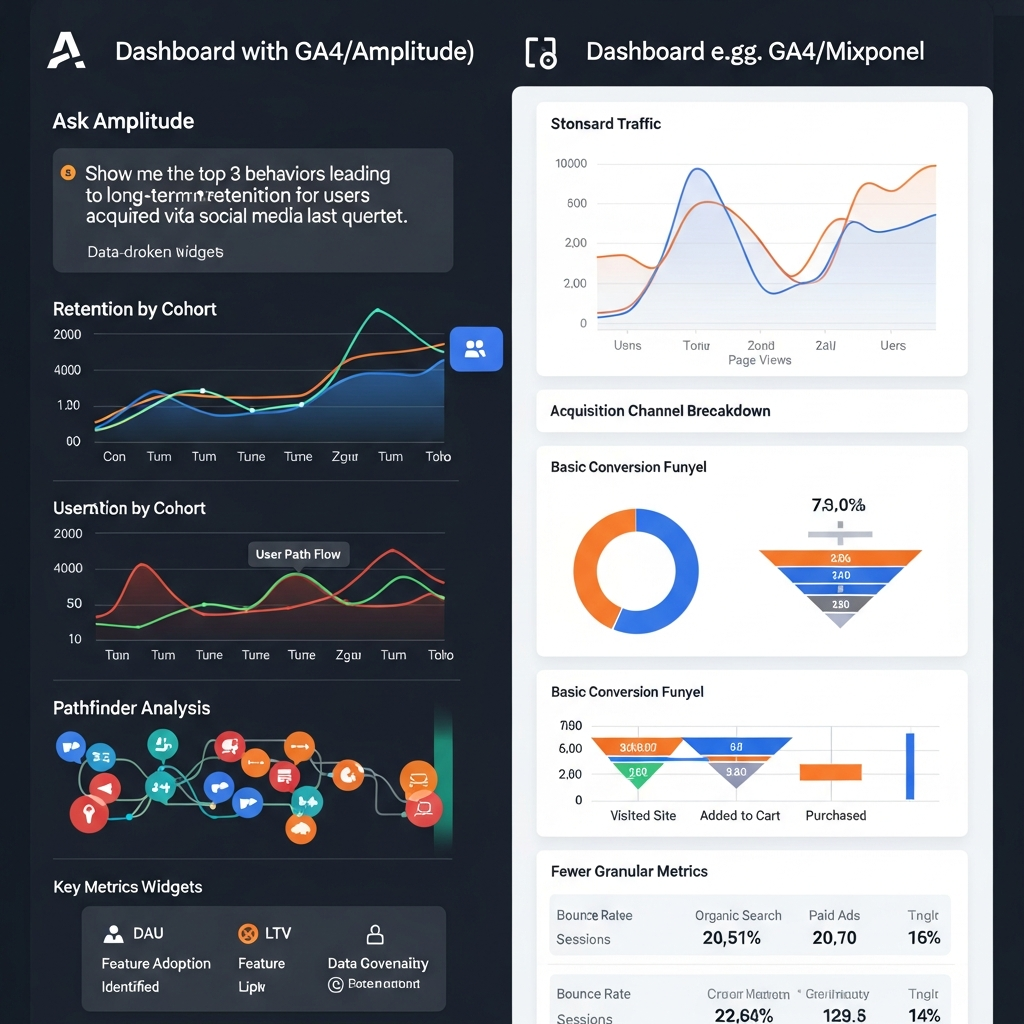

Quick Answer: Amplitude is a strong choice for SaaS, product-led growth and digital product teams that need deep behavioral analytics, funnels, retention, Session Replay, experimentation and AI-assisted analysis in one platform. Its Free plan includes 2 million events per month, while its current AI stack includes Global Agent, Specialized Agents and MCP. The biggest drawbacks are implementation complexity and custom pricing for larger Growth and Enterprise deployments.
Amplitude has changed substantially in 2026.
It is no longer best described simply as an event-tracking platform with an AI chatbot. Amplitude now combines product and web analytics, Session Replay, experimentation, activation, Guides and Surveys, AI Agents, AI Feedback, AI Visibility and MCP-based analytics workflows.
This Amplitude review examines what the platform actually does today, current pricing, AI capabilities, pros and cons, ideal use cases and how it compares conceptually with GA4 and Mixpanel.
Last Updated: September 3, 2026
Amplitude Review: Our Verdict
Amplitude is worth evaluating when your business needs to understand what users do after they enter your product—not just where traffic came from.
It is particularly well suited to:
- SaaS products
- Product-led growth companies
- Mobile applications
- Subscription businesses
- Product and growth teams
- Analytics organizations
- Enterprises managing complex behavioral data
Its biggest strength is the depth of its behavioral analytics combined with increasingly capable AI workflows.
Its biggest weakness is that the value depends heavily on implementation quality.
If your event taxonomy, user identities and product measurement strategy are poor, adding AI will not magically produce trustworthy insights.
Amplitude at a Glance
| Category | Amplitude |
|---|---|
| Primary use | Product and behavioral analytics |
| Free plan | Yes |
| Free event allowance | 2M events/month |
| Unlimited seats | Yes |
| Funnels | Yes |
| Retention analysis | Yes |
| Behavioral cohorts | Yes |
| Session Replay | Yes |
| Experimentation | Yes |
| AI Agents | Yes |
| MCP | Yes |
| AI Feedback | Yes |
| AI Visibility | Yes |
| Growth pricing | Custom |
| Enterprise pricing | Custom |
| Best for | SaaS, product, growth and analytics teams |
Amplitude's current pricing page says every plan includes its broader platform and unlimited seats, although allowances and advanced capabilities vary by plan.
What Is Amplitude?
Amplitude is a digital analytics platform designed to help teams understand how users interact with websites, applications and digital products.
A traditional traffic analytics question might be:
Where did visitors come from?
Amplitude is more focused on questions such as:
What did users do after they arrived?
Where did they abandon onboarding?
Which behaviors correlate with retention?
Which product features are being adopted?
What happened after an experiment shipped?
This behavioral focus makes Amplitude particularly relevant to product-led businesses.
What Is Amplitude AI in 2026?
Amplitude AI is now a collection of AI agents and AI-driven analytics workflows.
The current platform includes an always-available Global Agent plus specialized agents designed for recurring analytical jobs.
Global Agent
Global Agent sits throughout the Amplitude workspace.
Users can ask product questions in natural language and the agent can query product data, create charts, build cohorts and perform multi-step investigations.
For example:
“Why did conversion fall last week?”
“Show me 30-day retention for mobile users.”
“Which segment had the largest onboarding decline?”
Amplitude says Global Agent grounds answers in actual project data and links back to charts and analyses that support the answer.
That is considerably more useful than describing Amplitude's AI simply as “predictive analytics.”
Specialized Agents
Amplitude also provides purpose-built agents for repeatable workflows.
Current specialized agents include:
Dashboard Agent — monitors dashboards and surfaces trends and anomalies.
Session Replay Agent — analyzes groups of replays for friction and behavioral patterns.
Website Conversion Agent — analyzes conversion flows.
Customer Feedback Agent — synthesizes qualitative customer feedback.
These agents can run on schedules and send results through channels such as email or Slack.
Session Replay Agent
Session Replay Agent is particularly interesting for product and UX teams.
Instead of manually watching hundreds of sessions, it can analyze recorded sessions around specific funnels or events and surface:
- friction signals;
- drop-offs;
- navigation patterns;
- engagement issues;
- relevant replay clips.
This creates a stronger connection between quantitative analytics and qualitative behavioral evidence.
Amplitude MCP and AI Plugin
Amplitude can also connect its analytics environment to external AI tools through MCP.
This allows teams to work with Amplitude data from compatible AI clients rather than requiring every analysis to begin inside the Amplitude interface.
A major 2026 development was the Amplitude AI Plugin, released on May 1, 2026.
Amplitude says the plugin combines its MCP server with more than 25 reusable analytics skills spanning:
- analysis;
- instrumentation;
- monitoring;
- debugging;
- Session Replay;
- experimentation;
- dashboard creation.
The plugin is available through Claude and Cursor marketplaces, with downloadable implementations for Gemini and Codex.
For teams increasingly doing product work inside AI coding or agent environments, this significantly expands Amplitude beyond a traditional analytics dashboard.
Product Analytics
Product Analytics remains the foundation of Amplitude.
Teams can analyze:
- events;
- conversion funnels;
- retention;
- journeys;
- cohorts;
- user segments;
- product adoption.
Funnel Analysis
A SaaS onboarding funnel might look like:
Visit pricing → Create account → Create first project → Invite teammate → Upgrade
Amplitude can measure conversion between these stages and segment performance by user attributes, acquisition source or behavior.
This helps product teams identify where the largest losses occur.
Behavioral Cohorts
Amplitude also lets teams define audiences according to actions rather than demographics alone.
For example:
Users who created three projects during their first week
or:
Trial users who viewed pricing twice but never upgraded
These behavioral cohorts can be used in retention, conversion and product-growth analysis.
Retention and Journey Analysis
Retention answers whether users continue coming back after an initial action.
Journey analysis helps explain the sequence of actions people take across the product.
Used together, these reports can help investigate:
Which early behaviors correlate with retention?
Where does onboarding become confusing?
What happens before churn?
Which features are commonly used before conversion?
Avoid claiming that a correlation automatically causes retention. The analytics should generate hypotheses that teams then validate through research or experimentation.
Session Replay
Session Replay adds qualitative context to quantitative reports.
A funnel can tell you that users abandoned a particular step.
Replay can help reveal whether users:
- encounter an error;
- repeatedly click an inactive control;
- hesitate over an interface;
- leave after a confusing interaction.
Amplitude currently includes Session Replay across its platform with different usage allowances by plan.
Experimentation
Amplitude also includes experimentation capabilities.
This matters because product analytics is most useful when the organization can move from:
Observation → Hypothesis → Experiment → Measured result
without stitching together several disconnected systems.
Current plan access and usage levels vary, so teams should compare actual experimentation needs before selecting a tier.
Notebooks and Collaboration
Amplitude Notebooks remain useful for communicating analysis.
Notebooks can combine text, images, charts, summary metrics and explanatory commentary in one document.
Amplitude positions them as a way to explain insights and decisions to teammates rather than simply monitor metrics.
This makes them useful for product reviews, experiment analysis and executive reporting.
Amplitude Pricing in 2026
Current pricing differs substantially from older Amplitude reviews.
| Plan | Current Price |
|---|---|
| Free | $0 |
| Plus | Starts at $0 |
| Growth | Custom |
| Enterprise | Custom |
Free Plan
The Free plan currently includes 2 million events per month with no credit card requirement and no time limit.
Amplitude currently lists access to functionality including:
- Product Analytics
- AI Agents and MCP
- Agent Analytics
- Session Replay
- Experiments
- Guides and Surveys
- AI Feedback
- AI Visibility
with plan-specific allowances.
This is a much more accurate description than the old “Starter” framing.
Plus
Amplitude Plus now starts at $0.
The first 2 million monthly events are free, with pricing scaling as usage grows.
Therefore, old $49/month Amplitude Plus references should be removed.
Growth
Growth uses custom pricing and is intended for businesses that need greater analytics capacity and more advanced organizational functionality.
Enterprise
Enterprise also uses custom pricing.
Current Enterprise positioning adds stronger security, governance, RBAC, support and data-management capabilities.
For a deeper buying analysis, link naturally to your dedicated Amplitude Enterprise Pricing guide:
https://comparebestai.com/articles/amplitude-enterprise-pricing
Amplitude for Startups
Amplitude has a separate startup program worth mentioning because it materially changes the cost equation for qualifying companies.
Its Startup Scholarship currently offers one year of Growth access to eligible startups with:
less than $10 million in funding
and
fewer than 20 employees.
That is a stronger and more precise statement than claiming the standard Free plan will automatically “carry a startup through Series A.”
Amplitude vs GA4
Amplitude and Google Analytics 4 overlap, but the products emphasize different analytical workflows.
GA4 is commonly used for website traffic, acquisition and digital marketing measurement.
Amplitude is more deeply oriented around product behavior such as:
activation, feature adoption, retention, behavioral cohorts and user journeys.
A SaaS company may therefore reasonably use:
GA4 for acquisition measurement
and
Amplitude for product behavior
rather than treating the products as complete substitutes.
Amplitude vs Mixpanel
Mixpanel is a more direct product-analytics competitor.
Both products support event-based analytics, funnels, user segmentation and retention workflows.
The buying decision should therefore be based on specific requirements such as:
instrumentation → analytics workflow → experimentation → governance → integrations → pricing
rather than generic claims that one platform is universally “more advanced.”
If you publish a winner, document the testing criteria used to reach that conclusion.
Amplitude Security and Privacy
Amplitude currently documents support for several major security and privacy frameworks, including:
- SOC 2 Type 2;
- GDPR;
- HIPAA;
- CCPA.
That does not remove the customer's own compliance obligations.
Teams still need to configure user permissions, PII handling, retention, consent and access rules appropriately.
Amplitude Pros and Cons
| Pros | Cons |
|---|---|
| Deep behavioral product analytics | Requires thoughtful instrumentation |
| Strong funnel and retention analysis | Can be complex for beginners |
| Meaningful permanent Free plan | Growth and Enterprise prices are custom |
| AI Agents and MCP included | More platform than simple websites need |
| Session Replay integration | Usage can become more expensive at scale |
| Built-in experimentation | Data quality determines insight quality |
| AI Feedback and AI Visibility | Setup requires ongoing governance |
Who Should Use Amplitude?
Amplitude is a particularly strong fit for companies where business performance depends on understanding behavior inside the product.
That includes SaaS businesses, subscription products, digital marketplaces, mobile apps and product-led companies.
Teams that primarily need traffic reports and basic campaign metrics may not need the platform's full behavioral depth.
Is Amplitude Worth It in 2026?
Yes, for product-led organizations that will actually use its behavioral analytics, experimentation and AI capabilities.
Amplitude is less compelling when a company has no mature event-tracking strategy or only needs basic website reporting.
Its 2026 value proposition is now broader than simply funnels and retention.
The combination of:
Product Analytics + Session Replay + Experimentation + AI Agents + MCP + AI Feedback + AI Visibility
makes Amplitude a substantial product-growth platform rather than a simple analytics dashboard.
Final Verdict
Best fit: SaaS, product-led and analytics-heavy teams.
Main strength: behavioral analytics connected to AI-assisted analysis.
Main weakness: implementation and platform complexity.
Pricing advantage: meaningful Free tier with 2 million monthly events.
Enterprise consideration: larger plans require custom pricing and careful requirements planning.
CTA: Explore Amplitude's Current Features and Test the Free Plan →
Frequently Asked Questions About Amplitude
What is Amplitude used for?
Amplitude is used to analyze digital-product behavior, including funnels, retention, user journeys, feature adoption, cohorts, experimentation and Session Replay.
Does Amplitude have AI?
Yes. Current Amplitude AI includes Global Agent, specialized AI agents, custom agents, MCP connectivity, AI Feedback and AI Visibility.
Is Amplitude free?
Yes. Amplitude currently provides a permanent Free plan with 2 million events per month, no credit card requirement and no time limit.
How much does Amplitude Plus cost?
Amplitude Plus currently starts at $0, with the first 2 million monthly events free. Pricing scales as event volume increases.
Is Amplitude better than GA4?
Amplitude is more focused on behavioral product analytics, while GA4 is commonly used for traffic and acquisition measurement. Many SaaS organizations can benefit from using both rather than choosing only one.
Is Amplitude better than Mixpanel?
There is no universal winner. Both are event-based product analytics platforms. The better choice depends on analytics workflow, experimentation, governance, integrations and pricing requirements.
Is Amplitude secure?
Amplitude documents support for SOC 2 Type 2, GDPR, HIPAA and CCPA. Organizations remain responsible for configuring access, consent and data handling correctly.


