
AI software can look cheap until you actually start using it.
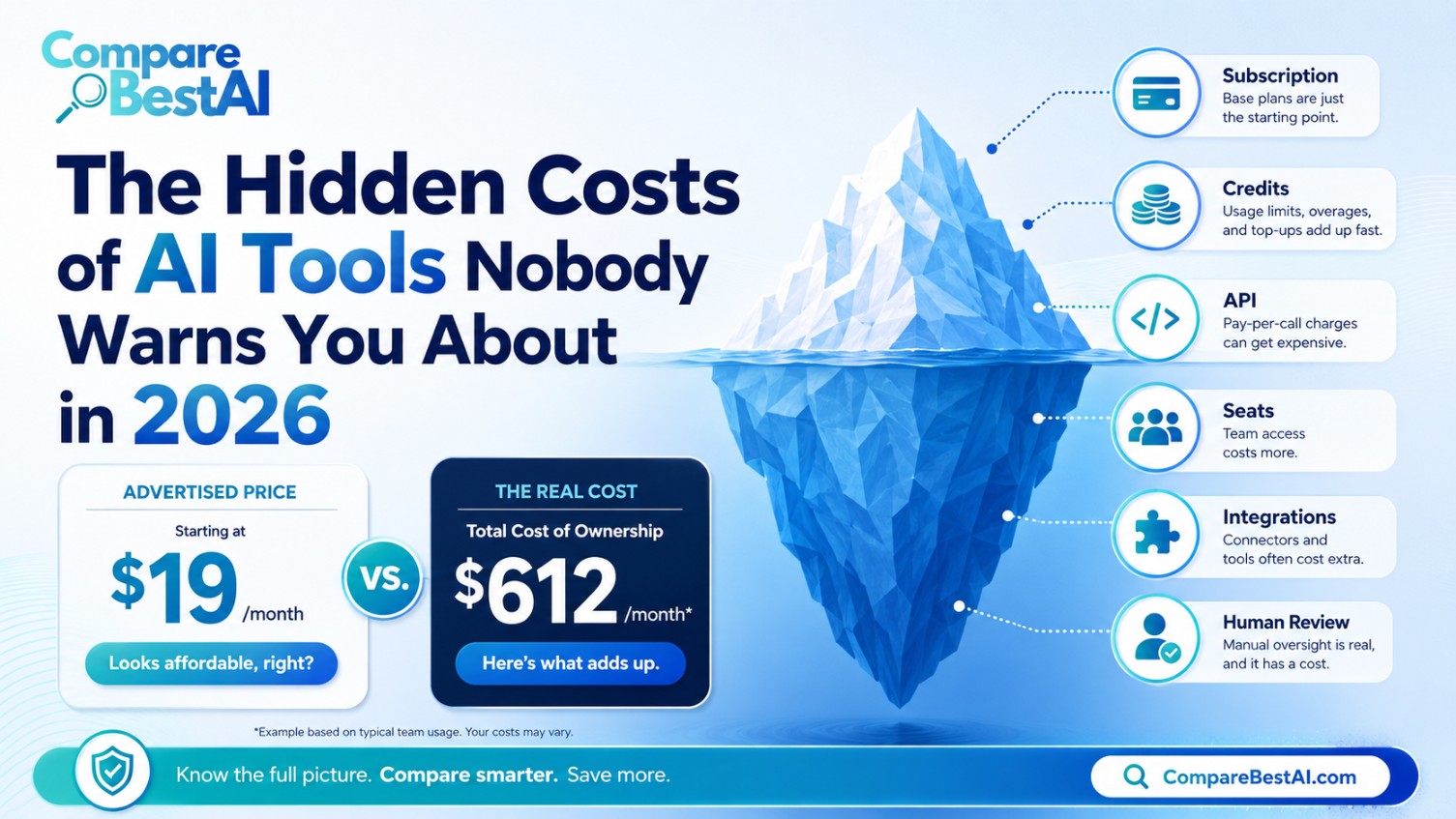
The hidden costs of AI tools usually come from usage credits, premium models, API calls, extra seats, integrations, storage, automation limits, onboarding, human review, and automatic renewals—not just the advertised monthly subscription.
For a solo user, that may mean paying $20 instead of the $10 you expected. For a growing U.S. team, the difference can become hundreds or thousands of dollars once the tool becomes part of a real workflow.
Quick answer: The safest way to buy an AI tool is to calculate its total cost of ownership, not its headline subscription price.
If you are still evaluating options, start by learning how to choose an AI tool and then use CompareBestAI to compare AI tools side by side.
[Insert image here: “Advertised AI Price vs Real AI Cost” visual showing Subscription + Credits + API + Seats + Integrations + Human Review.]
What Are the Hidden Costs of AI Tools?
Short answer: Hidden AI costs are expenses required to use, scale, integrate, or maintain an AI product that are not obvious from its headline monthly price.
They usually fall into two groups.
Direct costs appear on an invoice:
- Extra AI credits
- Usage overages
- Premium models
- Additional user seats
- API consumption
- Storage
- Add-ons
- Higher-tier integrations
Indirect costs may never appear on the vendor's invoice:
- Employee training
- Setup time
- Output verification
- Workflow redesign
- Compliance review
- Migration
- Duplicate software
- Failed generations
- Rework
This is why a simple AI tool pricing comparison can be misleading if you compare only the lowest monthly plan.
A $15 product with strict AI tool credit limits can cost more in practice than a $30 product with enough capacity for your normal workload.
Our guide to free vs paid AI tools can help you decide whether the upgrade itself is justified, while our list of AI tools with free plans is useful when you want to test before committing.
Hidden AI Cost Checklist
| Cost | What to Check Before Buying |
|---|---|
| Subscription | Monthly vs annual billing |
| Credits | How many generations/tasks are included? |
| Overage | What happens after the included allowance? |
| API | Input, output, media and tool usage charges |
| Seats | Price per additional team member |
| Models | Are the best models restricted to higher tiers? |
| Integrations | Are important integrations premium-only? |
| Storage | Included capacity and overage pricing |
| Automation | Task/run limits |
| Training | Time needed to onboard the team |
| Human review | Time spent checking AI output |
| Renewal | Renewal date and post-promotion price |
| Migration | Cost of leaving the platform |
7 AI Tool Pricing Traps That Can Cost More Than the Subscription
1. AI Credits That Run Out Faster Than Expected
Credits are one of the biggest AI tool pricing traps in 2026.
A plan may advertise “1,000 credits,” but that number means very little until you know what consumes a credit.
One image might cost one credit on one platform and dozens on another. Video generation may consume credits by second, resolution, model, or generation. Some platforms charge more for premium models.
Retries matter too.
Imagine generating a marketing video five times before getting one usable result. You did not create five finished videos—you created one—but your account may still have paid for all five attempts.
That makes AI credit pricing explained in real workflow terms more useful than simply stating the number of credits included.
Before buying, ask:
- How many credits does my normal task consume?
- Are failed or unwanted outputs charged?
- Do credits reset monthly?
- Do unused credits roll over?
- Can additional credits be purchased?
- Do premium models consume credits faster?
If cost predictability matters, also read our guide to monitoring AI tool pricing changes.
2. AI Tool Overage Charges and Usage-Based Billing
Subscription software is easy to understand because you normally know the bill before the month begins.
Usage-based AI is different.
AI tool usage fees may depend on tokens, requests, minutes, images, video seconds, storage, agent actions, or automated tasks.
This makes AI tool API costs especially easy to underestimate.
For example, a production workflow may involve:
User request → model input → model output → retrieval → another model call → validation → retry
One user action can therefore trigger multiple billable operations behind the scenes.
That is not necessarily bad pricing. Usage-based billing can be very efficient when properly monitored. The problem starts when a buyer estimates cost using only the price of one model call.
Before deploying an API-heavy workflow, estimate:
Monthly AI cost = requests × average cost per request × retry factor + supporting services
For teams building AI applications, our guide to AI APIs, features and free options provides additional context on API-based tools.
3. Per-Seat Pricing Multiplies Faster Than You Think
An individual plan can look affordable.
Then your manager wants access.
Then marketing needs three seats.
Then support wants four.
Then administrators need their own accounts.
This is where AI tool seat pricing becomes a real budgeting issue.
Consider a hypothetical example:
| Scenario | Cost |
|---|---|
| $25 plan × 1 user | $25/month |
| $25 plan × 10 users | $250/month |
| $25 plan × 50 users | $1,250/month |
| Annual cost for 50 seats | $15,000/year |
This example is hypothetical, but it shows why teams should calculate cost at the expected number of users—not the one-seat price displayed on a landing page.
Also check whether every employee really needs a paid seat. Some platforms offer viewer roles, shared workspaces, or usage-based alternatives.
For smaller companies, our comparison of AI tools for small businesses can help narrow choices before licensing an entire team.
4. Integrations and Automation Become Their Own Subscription Stack
An AI tool rarely lives alone.
You may connect it to:
- Slack
- Google Workspace
- Microsoft 365
- CRM software
- Zapier or Make
- A database
- Cloud storage
- Analytics software
- A CMS
- Customer-support software
The original AI subscription may be only one part of the stack.
For example, your AI assistant may be affordable, but making it automatically qualify leads, update a CRM, notify sales, create follow-up tasks, and write reports could require an automation platform plus API access.
That is an AI software hidden cost because the useful outcome depends on software outside the original purchase.
If automation is central to the business case, compare products designed to scale cleanly instead of breaking as usage grows.
5. The Cheapest Plan May Hide the Features You Actually Need
A starter plan may technically offer the product.
That does not mean it offers the workflow shown in the demo.
Useful capabilities may require an upgrade:
- Premium AI models
- Higher-quality exports
- API access
- Longer context windows
- Brand controls
- Team collaboration
- Admin controls
- SSO
- Advanced analytics
- Bulk processing
- Commercial-use features
- Priority generation
This creates one of the most common hidden fees in AI tools: paying for the basic plan, discovering that an essential capability is missing, and upgrading days later.
The better question is not:
“What is the cheapest plan?”
It is:
“What is the cheapest plan that contains everything required for my real workflow?”
If you are deciding whether higher-priced AI subscriptions provide enough extra value, see which AI tools are worth paying for long term.
6. Free Trials Can Become Paid Commitments
Free access is useful, but an AI tools free trial hidden cost can appear when the trial converts to a paid subscription or when the useful feature requires a card before testing.
For U.S. buyers, the Federal Trade Commission recommends checking renewal terms, expected renewal pricing, and the cancellation process when signing up for free trials and automatically renewing subscriptions. See the FTC's guidance on free trials, auto-renewals and subscriptions.
Before starting a trial, write down:
- Trial end date
- Whether a credit card is required
- Which plan starts after the trial
- Renewal price
- Monthly or annual commitment
- Cancellation deadline
- Refund policy
- Whether unused credits disappear
AI tool auto renewal is not automatically a bad thing. The problem is forgetting what you agreed to.
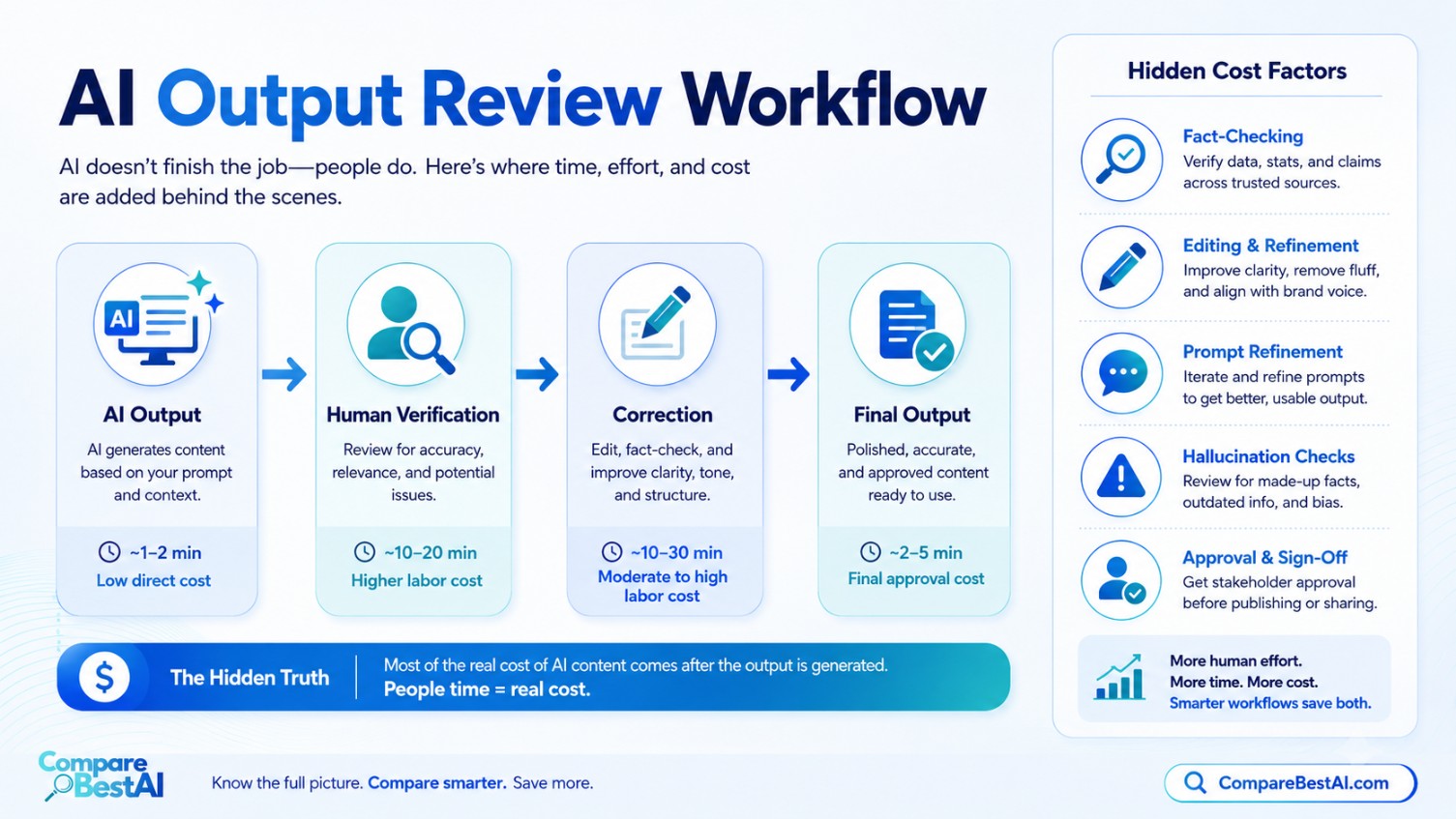
7. Human Oversight Is Still a Cost
AI can reduce work without eliminating work.
Someone still has to decide whether the result is accurate enough to publish, send, deploy, or act on.
Common human costs include:
- Fact-checking
- Editing
- Prompt refinement
- Reviewing hallucinations
- Fixing formatting
- Checking citations
- Approving customer-facing output
- Reviewing generated code
- Monitoring automated agents
A workflow that saves three hours but requires two hours of correction is very different from one that saves three hours and needs ten minutes of review.
That is why CompareBestAI's own evaluation approach considers pricing alongside ease of use, features, support, reliability, and integrations rather than looking at price alone.
For a productivity-focused perspective, compare AI tools that actually save time for teams and our current guide to AI productivity tools.
How Much Do AI Tools Really Cost?
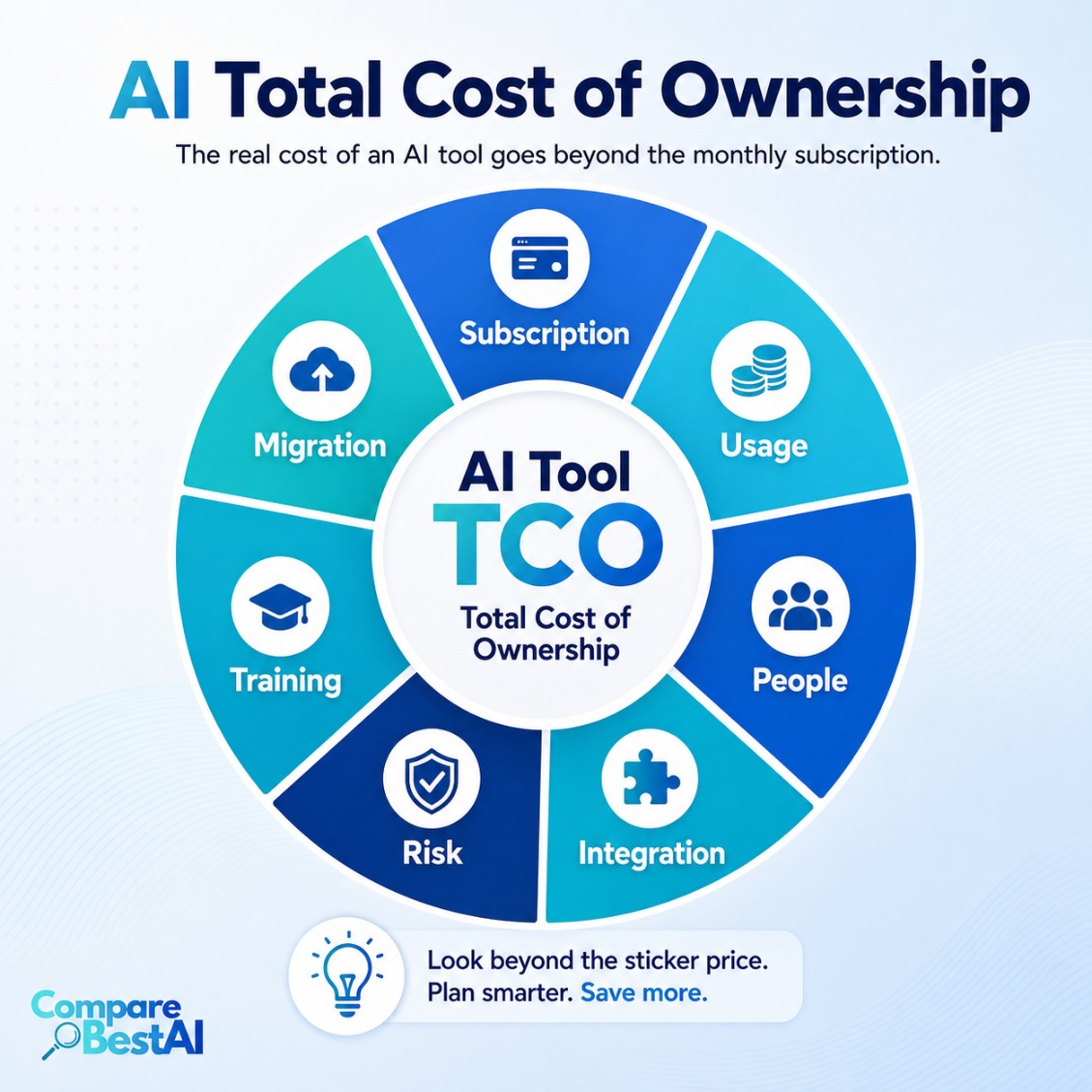
Short answer: The real cost of an AI tool is the subscription plus usage, seats, integrations, implementation, training, oversight, and eventual switching costs.
A useful formula is:
AI Tool TCO = Subscription + Usage + Seats + Integrations + Setup + Training + Human Review + Governance + Migration
This is your AI tool total cost of ownership, or TCO.
Example: A 10-Person Marketing Team
Suppose a fictional marketing team buys an AI product.
The numbers below are illustrative—not vendor pricing.
| Expense | Example Monthly Cost |
|---|---|
| AI subscription seats | $300 |
| Additional credits | $150 |
| Automation platform | $100 |
| API usage | $125 |
| Other integrations | $75 |
| Human review time | $500 |
| Estimated real monthly cost | $1,250 |
The subscription line is only 24% of this hypothetical total.
That is why asking “How much do AI tools really cost?” produces a better purchasing decision than comparing plan cards alone.
Is AI Actually Saving Me Money or Costing Me More?
Measure the value created by the tool.
A simple monthly ROI model is:
ROI = (Value of time saved + additional value created − total AI cost) ÷ total AI cost
Do not count time saved if employees simply spend that time correcting AI mistakes.
The goal is net productivity, not the number of tasks generated by AI.
What Is the Real Cost of AI Tool Sprawl?
Tool sprawl happens when a team keeps adding AI subscriptions without removing overlapping products.
Marketing has one writer.
Sales buys another.
Operations adds a meeting assistant.
Management buys a general chatbot.
A developer introduces an automation agent.
Three months later, the company is paying for five tools that perform several of the same tasks.
The hidden costs include more than subscription fees:
- Duplicate functionality
- Multiple logins
- Fragmented knowledge
- Inconsistent workflows
- More security reviews
- More vendors to manage
- Additional employee training
- Migration difficulty
- Lost time switching between platforms
Before adding another subscription, audit what the current stack already does.
Our guide to common mistakes when choosing AI tools covers several buying decisions that lead to unnecessary software spend.
Vendor Lock-In Can Turn Today's Discount Into Tomorrow's Expense
One of the least visible AI subscription hidden fees may not appear until you decide to leave.
Teams build:
- Prompt libraries
- Agents
- Automations
- Proprietary workflows
- Knowledge bases
- Templates
- Integrations
- Employee habits
around a platform.
Switching later may require exporting data, rebuilding automations, retraining employees, testing a replacement, and operating both products during migration.
That is economic lock-in even when the vendor does not charge a formal exit fee.
Before adopting mission-critical AI, ask whether you can export:
- Data
- Conversation history
- Knowledge bases
- Prompts
- Generated assets
- Workflow configurations
For a deeper look at this issue, read AI platforms that lock you in and how to avoid it.
How Much Should a Business Budget for AI Governance and Risk?
Governance becomes more important when AI handles customer information, company knowledge, regulated data, decisions, code, or public-facing content.
Possible costs include:
- Security reviews
- Access controls
- Data classification
- Vendor assessments
- Employee policies
- Output monitoring
- Audit records
- Testing
- Legal or compliance review
- Incident response planning
There is no universal governance budget because risk varies by use case.
A chatbot used to brainstorm social captions is not the same risk profile as an AI system processing confidential financial or health information.
For organizations formalizing AI risk management, the U.S. National Institute of Standards and Technology provides the NIST AI Risk Management Framework and Generative AI guidance. The framework is voluntary and designed to help organizations incorporate trustworthiness considerations into the design, development, use, and evaluation of AI systems.
This is another reason AI software total cost should include governance rather than treating it as an afterthought.
How to Avoid Unexpected AI Bills: 8 Steps
Step 1: Define One Real Use Case
Do not purchase an AI tool because it has 50 impressive features.
Define the specific task it must improve.
Step 2: Calculate Cost at Your Expected Usage
Estimate normal and high-volume months.
Do not calculate from the minimum advertised plan.
Step 3: Test the Exact Workflow
Run realistic documents, images, meetings, prompts, APIs, or automation workloads during the trial.
Step 4: Measure Failure and Retry Rates
If ten generations produce three usable outputs, budget based on ten—not three.
Step 5: Check All Upgrade Triggers
Look for:
- Credit limits
- API restrictions
- Seat limits
- Export restrictions
- Premium models
- Storage caps
- Automation limits
Step 6: Calculate Human Time
Include onboarding, prompting, checking, correcting, and maintaining workflows.
Step 7: Check the Exit Plan
Know how to export your work before becoming dependent on the platform.
Step 8: Review AI Spend Quarterly
Cancel unused and overlapping tools.
A useful starting point is to compare the best AI tools for 2026 rather than purchasing products separately without a consistent evaluation framework.
Quick Pros and Cons of AI Tool Pricing Models
| Pricing Model | Advantage | Hidden-Cost Risk |
|---|---|---|
| Flat subscription | Predictable | Features may be gated |
| Per-seat | Easy for small teams | Expensive when team grows |
| Credits | Flexible | Hard to compare true unit cost |
| Usage/API | Pay for actual use | Bills can vary sharply |
| Free trial | Easy to test | May convert or lose features |
| Freemium | No initial cost | Low limits may force upgrade |
| Enterprise | Better control/support | Custom pricing and commitments |
Key Takeaway
The best pricing model is not always the lowest-priced one. It is the one whose cost stays predictable at your expected level of usage.
Frequently Asked QuestionsThe hidden costs of AI tools can include usage credits, API calls, extra seats, premium features, storage, integrations, automation platforms, training, human review, governance, overages, renewal increases, and migration costs.
How much do AI tools really cost?AI tools can cost substantially more than their advertised subscription once usage, seats, integrations, training and human oversight are included. Calculate total cost of ownership rather than using the lowest plan price.
Are there hidden fees in AI API pricing I should watch for before scaling?Potential API cost drivers include input and output usage, repeated calls, retries, long contexts, media generation, retrieval, storage, supporting infrastructure, and other services triggered by a single workflow. Model the complete request chain before scaling.
How can I reduce unexpected AI bills from usage overages and retries?Set usage budgets, monitor consumption, reduce unnecessary retries, use appropriate models for each task, test workflows before scaling, configure alerts, and review cost per successful output rather than cost per individual API call.
What is the real cost of AI tool sprawl for a team?AI tool sprawl creates subscription duplication, employee training costs, workflow fragmentation, extra security reviews and more administration. Audit overlapping functionality regularly and remove products that do not provide distinct value.
How much should I budget for AI integration, training and governance?There is no fixed percentage that fits every company. Budget separately for implementation, integrations, employee onboarding, human review, security, governance and ongoing maintenance, then add those costs to the subscription when calculating AI tool TCO.
Which AI tools have the lowest total cost of ownership?The lowest-TCO tool is the one that meets your required workload with the fewest extra credits, integrations, seats and manual steps. A more expensive subscription can have lower TCO if it replaces several other tools or saves substantially more employee time.
Why is my AI project's ROI lower than expected?Common causes include underestimated human review, low-quality outputs, failed generations, integration work, overages, duplicated software and slow employee adoption. Compare projected savings with actual monthly costs and measurable hours saved.
Final Verdict: Look Beyond the Price TagThe biggest mistake in AI buying is assuming that the number on the pricing page is the cost of the tool.
It is only the starting point.
The hidden costs of AI tools come from how the product behaves after you put it into a real workflow: how many credits you burn, how many people need seats, how often the AI needs correction, which features require upgrades, what other software it depends on, and how difficult it becomes to leave.
For most buyers, the best option is not automatically the cheapest AI tool.
It is the tool with the best total value after all costs are counted.
At CompareBestAI, our goal is to make those buying decisions easier by comparing AI tools across pricing, features, reliability, integrations, business value, and real-world fit rather than relying only on marketing claims. CompareBestAI publicly describes its approach as independent comparison and says rankings are not sold to vendors.
Before paying for your next subscription, see how CompareBestAI evaluates AI tools, calculate the real cost of the workflow, and choose the product that will still make financial sense after the trial ends.