

Quick Answer Gate.io (now branded Gate, at gate.com) is a centralized crypto exchange founded in 2013 that lists more than 5,200 digital assets, with spot fees starting at 0.2% and futures fees at 0.02% maker / 0.05% taker. It suits experienced altcoin and futures traders outside the United States. US residents cannot legally use it: Gate's user agreement lists the US as a restricted location. Americans should compare Bitstamp or Gemini ActiveTrader instead. CBAI score: 6.8/10 · Best for: non-US traders who want early access to small-cap altcoins
This Gate.io review covers fees, supported coins, Proof of Reserves data, security history and how Gate compares with Binance, Bitfinex and US-available exchanges. Our verdict: Gate.io offers one of the widest altcoin selections of any exchange, backed by regular reserve reporting, but its complex interface, past security incidents and unavailability in the US limit who should use it.
Gate.io at a glance
| Attribute | Detail |
|---|---|
| What it is | Centralized cryptocurrency exchange (spot, margin, futures, earn) |
| Founded | 2013 as Bter; renamed Gate.io in 2017; rebranded as Gate (gate.com) in May 2025 |
| Founder | Lin Han |
| Supported assets | 5,200+ digital assets (per Gate's exchange profile, September 2026) |
| Spot fees (entry tier) | 0.2% maker / 0.2% taker, lower with GT and VIP tiers |
| Futures fees (entry tier) | 0.02% maker / 0.05% taker |
| Proof of Reserves | Published since 2020; Merkle tree plus zk-SNARK verification |
| Registered users | 27 million+ (Gate, May 2025) |
| US availability | Not available: the US is a restricted location |
| Native token | GateToken (GT), used for fee discounts |
| CBAI score | 6.8/10 |
Gate.io Review Summary: Key Takeaways
- Huge altcoin selection. Gate lists more than 5,200 digital assets, far more than Binance or Coinbase, and often lists new tokens before larger exchanges.
- Mid-range fees. Spot trading starts at 0.2% per side, twice Binance's 0.1% entry rate. GT holdings and VIP tiers bring it down.
- Reserve reporting is a real strength. Gate reported a 128.57% reserve ratio on $10.865 billion in reserves in May 2025.
- Security history is mixed. The exchange lost over 7,000 BTC in a 2015 hack (as Bter) and was hit by an Ethereum Classic 51% attack in 2019.
- Not for US residents. Gate does not serve US persons, so American traders need a US-licensed exchange.
What Is Gate.io?
Gate.io is a centralized cryptocurrency exchange that lets users trade spot crypto, margin and perpetual futures, and earn yield on deposited assets from one account. It was founded in 2013 by Lin Han under the name Bter, renamed Gate.io in 2017, and moved to the new brand name Gate and the domain gate.com on May 19, 2025. Most users and search engines still call it Gate.io.
Gate is best known for breadth. Its exchange profile lists more than 5,200 digital assets, and the platform regularly adds small-cap tokens earlier than larger exchanges. Beyond trading, Gate runs an earn marketplace (supporting nearly 1,000 assets as of May 2025), a token launch platform called Startup, trading bots, copy trading, an NFT marketplace and a self-custody Web3 wallet.
Gate reported more than 27 million registered users in May 2025 and ranked second worldwide for 24-hour spot trading volume in its own transparency report for that month.
Is Gate.io available in the US?
No. Gate's user agreement lists the United States as a Restricted Location, alongside Canada, the United Kingdom, Japan and more than 30 other jurisdictions, and states that Gate does not intend to serve US persons. If you live in the US, open an account with a US-licensed exchange such as Bitstamp or Gemini ActiveTrader instead. Using a VPN to get around this restriction breaks Gate's terms and can lead to a frozen account.
Gate.io Fees in 2026
Opening a Gate account and depositing crypto is free. You pay trading fees on each order, network fees on crypto withdrawals, and third-party processor fees if you buy crypto with a card or bank transfer. Gate updated its fee schedule on April 9, 2026, so older reviews may quote different numbers.
| Fee type | Entry-tier rate | How to lower it |
|---|---|---|
| Spot trading | 0.2% maker / 0.2% taker | Hold or pay fees in GT; reach higher VIP tiers by 30-day volume |
| Perpetual futures | 0.02% maker / 0.05% taker | VIP tiers; futures also carry funding rates |
| Crypto deposits | Free | Not applicable |
| Crypto withdrawals | Varies by coin and network | Choose a cheaper network where the coin supports several |
| Card and fiat purchases | Set by third-party payment partners | Buy on a regulated fiat on-ramp, then transfer crypto |
Entry-tier rates from 2026 fee breakdowns. Gate shows your exact rates on its fee page after you log in.
Is Gate.io cheaper than Binance?
Not at the entry tier. Binance charges 0.1% per spot trade versus Gate's 0.2%, so a $10,000 spot trade costs about $10 on Binance and about $20 on Gate before discounts. For futures, both exchanges sit in a similar range. Gate's case rests on coin selection rather than price: if the token you want is only listed on Gate, the fee difference matters less. Read our Binance Pro review for the full fee comparison.
Hidden costs to watch
- Withdrawal fees on some assets. Several 2026 fee breakdowns report withdrawal fees above the underlying network cost for certain coins. Check the withdrawal screen before you move funds.
- Funding rates on perpetual futures. Long or short positions pay or receive funding at set intervals. Holding a leveraged position for weeks can cost more than the trading fee.
- Card purchase spreads. Third-party payment partners set their own fees and exchange rates, which can make small card purchases expensive.
- Lock-up opportunity cost. Fixed-term earn products and launch events lock your funds. There is no fee, but you can't sell during a price drop.
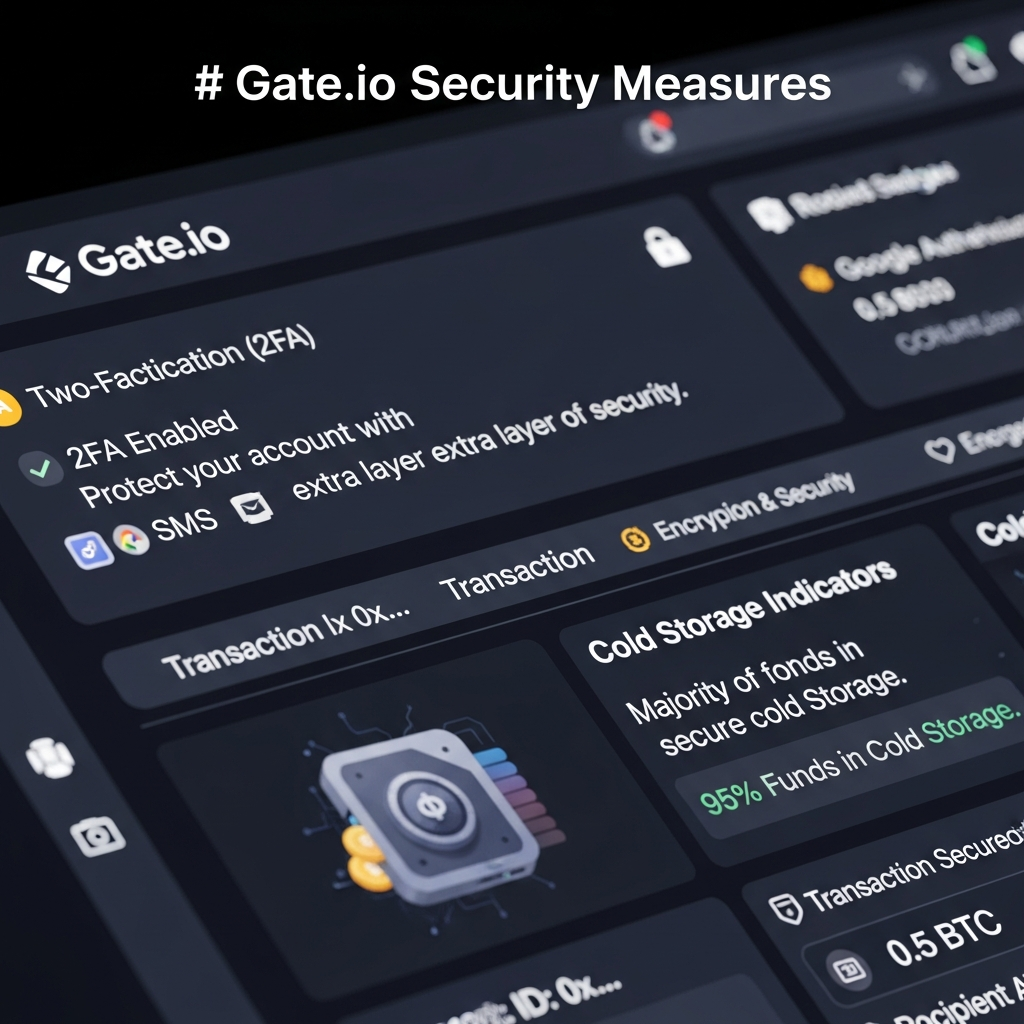 Is Gate.io Safe? Security and Proof of Reserves
Gate.io is one of the more transparent exchanges on reserves, but its security record is not clean. Here are the facts that matter.
Proof of Reserves
Gate has published Proof of Reserves since 2020 and describes itself as the first mainstream exchange committed to 100% reserves. Its current system stores a hash of each user's balance in a Merkle tree and uses zk-SNARK proofs so you can confirm your balance is included without exposing other users' data. The verification code is open source on GitHub, and security firm Hacken audited the setup in January 2024.
| Report | Total reserves | Reserve ratio |
|---|---|---|
| January 2025 | $10.328 billion | 128.58% |
| May 2025 | $10.865 billion | 128.57% (BTC: 137.69%) |
| Gate exchange profile, September 2026 | $8.182 billion | 115% |
A ratio above 100% means Gate reported holding more assets than it owes users. Proof of Reserves does not prove the absence of hidden liabilities, so treat it as a strong signal, not a guarantee. You can check live figures on Gate's Proof of Reserves page.
Security incidents
- 2015: While operating as Bter, the exchange lost more than 7,000 BTC in a hack.
- January 2019: An Ethereum Classic 51% attack cost Gate roughly $270,000 in ETC. About $100,000 was returned a week later.
No large exchange-wide breach has been widely reported since 2019. Gate protects accounts with two-factor authentication, anti-phishing codes, withdrawal address whitelists and login alerts.
How to keep your Gate account secure
- Turn on app-based two-factor authentication instead of SMS.
- Set an anti-phishing code so you can spot fake Gate emails.
- Enable the withdrawal whitelist so funds can only go to addresses you approve.
- Store your password in a password manager such as 1Password Teams.
- Move long-term holdings to a self-custody wallet rather than leaving them on any exchange.
Gate.io Features: What Stands Out
Spot trading and early listings
Gate's main draw is its spot market. With more than 5,200 assets, it lists tokens that are hard to find elsewhere, and it often adds new projects before larger exchanges. The trade-off is quality control: small-cap tokens carry high volatility and low liquidity, and some fail entirely.
Futures and margin trading
Gate offers USDT-margined and coin-margined perpetual futures, with high leverage (up to 100x) on select contracts, plus margin trading on spot pairs. Leverage magnifies losses as well as gains, and liquidations can wipe out a position in minutes. These products are for experienced traders only.
Gate Earn and Startup launches
Gate Earn offers flexible and fixed-term savings, staking, dual investment and lending across nearly 1,000 assets (May 2025 figure). Startup is Gate's token launch platform, where users commit funds to receive allocations of new tokens before they trade publicly.
Trading bots and copy trading
Gate includes built-in grid bots and copy trading, so you can automate simple strategies or mirror other traders without third-party software. For more control across several exchanges, dedicated bot platforms such as 3Commas or Bitsgap offer deeper strategy settings.
Mobile app and Web3 wallet
The Gate app for iOS and Android covers spot, futures, earn and account security. Gate also offers a separate self-custody Web3 wallet. Reviewers consistently describe the app as powerful but crowded, which is the main source of Gate's low ease-of-use score.
NFT marketplace
Gate runs an NFT marketplace inside the same account. It works, but its trading volume is small next to dedicated NFT platforms, so it is a side feature rather than a reason to choose Gate.
Gate.io Pros and Cons
Pros
- One of the largest coin selections of any exchange, with 5,200+ digital assets
- Early listings of new and small-cap tokens
- Regular Proof of Reserves reporting, with reserve ratios above 100% in every figure we reviewed
- Low futures fees at 0.02% maker and 0.05% taker
- Full product range in one account: spot, margin, futures, earn, bots and copy trading
- Free crypto deposits
Cons
- Not available in the US, Canada, the UK, Japan and many other countries
- Spot fees of 0.2% are double Binance's 0.1% entry rate
- Past security incidents, including the 2015 Bter hack and a 2019 ETC attack
- Crowded interface that overwhelms beginners
- Small-cap listings carry high risk, with thin liquidity and frequent failures
- Limited fiat options, relying on third-party payment partners
Who Should Use Gate.io?
Gate.io is best for
- Experienced altcoin traders outside the US who want tokens not listed on larger exchanges
- Futures traders who want low maker and taker fees and high leverage on a wide range of contracts
- Yield seekers who want many earn products in one place and accept lock-up and counterparty risk
- Traders who value reserve transparency and check Proof of Reserves reports regularly
Gate.io is not ideal for
- US residents. Gate does not serve US persons. Use a US-licensed exchange such as Bitstamp or Gemini ActiveTrader.
- First-time crypto buyers. The interface is complex and fiat on-ramps are limited.
- Cost-focused spot traders. Binance (outside the US) charges half the entry spot fee.
- Investors who only want Bitcoin and Ethereum. You don't need 5,200 coins to buy the two largest ones.
 Gate.io vs Binance, Bitfinex and US Alternatives
| Exchange | Available in the US? | Spot fee (entry tier) | Best for |
|---|---|---|---|
| Gate.io | No | 0.2% / 0.2% | Altcoin selection, early listings |
| Binance | No (Binance.US is a separate company) | 0.1% / 0.1% | Liquidity, low fees |
| Bitfinex | No | 0.1% maker / 0.2% taker | Advanced order types, margin funding |
| BingX | No | 0.1% / 0.1% | Copy trading |
| Bitstamp | Yes | 0.30% maker / 0.40% taker | US traders who want a long-running, licensed exchange |
| Gemini ActiveTrader | Yes | 0.20% maker / 0.40% taker | US traders who want a regulated, security-focused platform |
Entry-tier list rates; all exchanges lower fees with trading volume. Confirm current rates on each exchange's fee page.
Gate.io vs Binance
Binance has deeper liquidity and a lower 0.1% entry spot fee, so it is cheaper for trading major coins. Gate lists far more small-cap tokens and often lists them earlier. Neither is open to US residents on its main international platform. Choose Binance for cost and liquidity, and Gate for token selection. See our Binance Pro review 2026.
Gate.io vs Bitfinex
Bitfinex targets professional traders with advanced order types and peer-to-peer margin funding, and its entry fees are lower than Gate's. It lists far fewer coins. Bitfinex also does not onboard US residents and settled with the New York Attorney General in 2021.
Gate.io vs Bitstamp (best US-available option)
Bitstamp has operated since 2011, holds US licenses and was acquired by Robinhood in June 2025. It lists far fewer coins than Gate and charges more per trade at low volumes, but US residents can use it legally with bank deposits.
Best Gate.io Alternatives in 2026
- Bitstamp: Best for: US traders who want a licensed exchange with bank funding. Entry fees 0.30% maker / 0.40% taker. Read our full Bitstamp review.
- Gemini ActiveTrader: Best for: US traders who prioritize regulation and security. Entry fees 0.20% maker / 0.40% taker.
- Interactive Brokers: Best for: US investors who want crypto alongside stocks and ETFs in one brokerage account.
- Binance: Best for: non-US traders who want the deepest liquidity and 0.1% spot fees.
- Bitfinex: Best for: non-US professional traders who need advanced order types.
- BingX: Best for: non-US traders interested in copy trading.
- dYdX: Best for: traders who want perpetual futures on a decentralized exchange. Check local rules before using it.
Trading tools that work with Gate.io
If you trade on Gate from an eligible country, these tools add analysis and automation:
- Pionex: an exchange with built-in grid bots, useful for comparing bot fees against Gate's own bots.
- Bitsgap and 3Commas: bot platforms that connect to several exchanges through API keys.
- Gunbot: a self-hosted trading bot for active traders who want full control. Try Gunbot
- TradingView Premium: charting and alerts for planning trades before you place them on Gate.
Compare every exchange and trading tool in our Finance & Trading category.
How We Evaluated Gate.io
CompareBestAI scores every tool with the same framework, described in how we rank tools and our editorial guidelines. For this Gate.io review we assessed:
- Fees: published spot, futures, deposit and withdrawal rates, including the April 2026 fee update
- Security: Proof of Reserves reports (January 2025, May 2025 and September 2026 figures), audit details and the public incident record
- Access: Gate's user agreement and its list of restricted locations
- Features: spot, futures, earn, bots, copy trading, app and wallet, checked against Gate's documentation
- Fit: how well the platform matches beginners, active traders and US-based readers
We did not open a funded Gate account for this review, because Gate does not serve US persons. Figures come from Gate's own documentation, its transparency reports and independent 2026 fee breakdowns, and we name the source for each.
Gate.io Review FAQs
Is Gate.io legit and safe?
Gate.io is a legitimate exchange operating since 2013, with over 27 million registered users and Proof of Reserves ratios above 100% in every recent report. Its record includes a 2015 hack (as Bter) and a 2019 ETC attack. Use two-factor authentication and a withdrawal whitelist, and don't keep long-term holdings on any exchange.
Can I use Gate.io in the US?
No. Gate's user agreement lists the United States as a restricted location and says it does not serve US persons. US residents should use a US-licensed exchange such as Bitstamp or Gemini instead. Using a VPN to access Gate breaks its terms and risks a frozen account.
What are Gate.io's trading fees?
Gate charges 0.2% maker and 0.2% taker on spot trades at the entry tier, and 0.02% maker and 0.05% taker on perpetual futures. Holding or paying fees in GT and reaching higher VIP tiers lowers these rates. Crypto deposits are free; withdrawal fees vary by coin and network.
How many coins does Gate.io support?
Gate lists more than 5,200 digital assets according to its exchange profile in September 2026, up from 3,800+ in April 2025. That makes it one of the largest selections of any exchange, especially for new and small-cap tokens.
Has Gate.io ever been hacked?
Yes. In 2015, while operating as Bter, the exchange lost more than 7,000 BTC in a hack. In January 2019, a 51% attack on Ethereum Classic cost Gate roughly $270,000, of which about $100,000 was later returned. No large exchange-wide breach has been widely reported since.
Is Gate.io better than Binance?
Gate.io is better for traders who want small-cap tokens and early listings. Binance is better for liquidity and cost, with a 0.1% entry spot fee versus Gate's 0.2%. Neither international platform is available to US residents.
Final Verdict: Is Gate.io Worth It in 2026?
Gate.io is worth considering for experienced traders outside the US who want access to thousands of altcoins, low futures fees and an exchange that publishes Proof of Reserves regularly. Its spot fees are higher than Binance's, its interface is crowded, and its security record includes past incidents, so it suits traders who know the risks of small-cap tokens and leverage.
For US readers, the answer is simple: Gate does not serve US persons, so choose a US-licensed exchange such as Bitstamp or Gemini ActiveTrader.
CBAI score: 6.8/10. Best for non-US traders who want early access to small-cap altcoins.
See Gate.io's full score and specs → · Compare Gate.io with other exchanges →
About CompareBestAI: CompareBestAI compares AI tools and the software people use to run their businesses and investments, from AI writers to crypto trading platforms, with transparent pricing checks and a consistent scoring method. Get new reviews in our newsletter →